Proudly serving Tucson, Oro Valley, Marana, Sahuarita, Green Valley, Vail & surrounding areasCall or Text 24/7: 520-569-2109

Reflective Roof Coating and Elastomeric Systems in Tucson, AZ

Tucson Quality Roofing provides roof coating in Tucson, Arizona, for homes, commercial properties, and other buildings exposed to the Sonoran Desert climate. Our crews apply acrylic elastomeric, silicone, rubberized, reflective, and polyurethane foam systems according to the roof type, slope, and substrate condition. We also handle roof repair, roof replacement, tile and flat roof repair, foam, shingle, and metal roofing, emergency roof leak repair, and commercial roofing when the roof needs more than a maintenance coat. Property owners across Pima County can start with an on-roof evaluation and a written estimate.

Tucson roof surfaces routinely reach 150-180 degrees Fahrenheit on summer afternoons, while monsoon downpours and winter freeze-thaw swings add different stresses. A coating can protect a structurally sound roof, but it should not hide failed flashing, deck rot, delamination, or drainage problems. Because we are a full roofing contractor, we check those conditions before selecting a coating. If a roof is chalking, cracking, or holding water, we can walk it and explain whether repair, recoating, or replacement is the sounder approach.

Coating applications follow manufacturer specifications and ASTM D6083 elastomeric coating standards, with permits coordinated through the City of Tucson Development Services Department or Pima County Development Services when the project requires them.

Tucson Quality Roofing provides roof coating in Tucson, Oro Valley, Marana, Sahuarita, Vail, and the surrounding metro area.

★ ★ ★ ★ ★4.9/5 Average Rating · 20+ Years of Experience · Thousands of Customers Helped · Licensed & Insured · Residential & Commercial

Roof Coating Options & Benefits

What Is Roof Coating?

Roof coating is a fluid-applied protective membrane for a roof that remains structurally sound. Depending on the existing surface and drainage, acrylic elastomeric, silicone, rubberized, reflective, or polyurethane foam products can renew waterproofing and shield the assembly from intense UV exposure.

The correct system depends on roof type, slope, substrate condition, ponding exposure, and the compatibility of the coating with materials already in place. Acrylic adheres well to foam, metal, and many cap sheets, while silicone is better suited to prolonged moisture exposure and foam can add insulation as part of a complete system.

A coating is not a substitute for repairing rotted decking, extensive delamination, major flashing damage, or poor drainage. Those underlying conditions must be identified and corrected so the new membrane can bond and perform as intended.

Benefits of Roof Coating

A properly selected coating can renew a sound roof without the cost and disruption of an immediate tear-off. In Tucson, the most useful benefits center on reflectivity, waterproofing, flexibility, and protecting vulnerable roof materials from desert weather.

  • Reflects solar radiation instead of absorbing it into the roof assembly
  • Reduces heat transfer into attics and occupied spaces
  • Seals seams, pipe boots, drain edges, and roof transitions
  • Flexes with daily roof-deck expansion and contraction
  • Protects foam roofing from UV degradation and moisture intrusion
  • Helps inhibit corrosion on properly prepared metal roofing
  • Can extend the service life of a structurally sound roof
  • Allows maintenance recoating before weathering becomes an interior leak
Coating Applications

Roof Coating Services

Different roofs create different coating demands. We tailor preparation, primer, repairs, and topcoat chemistry to the substrate, drainage, sun exposure, property use, and existing membrane rather than applying one product to every surface.

Rubberized Roof Coating

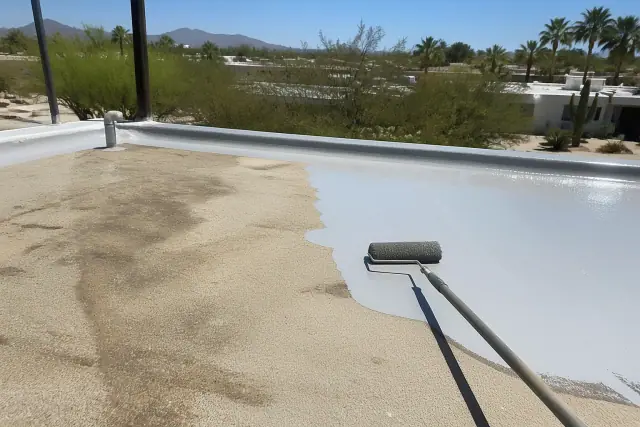
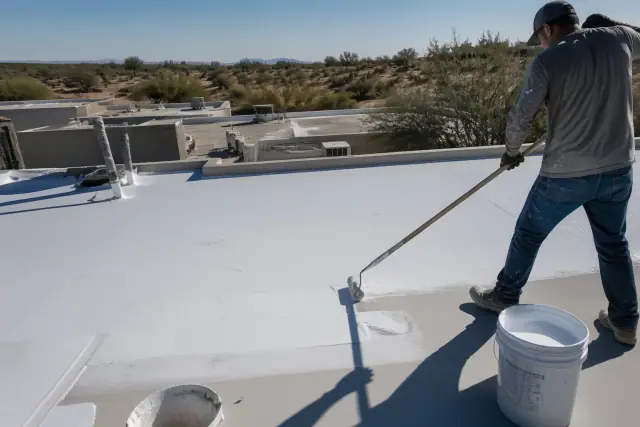
Contractor applying rubberized roof coating to a flat residential roof in Tucson, AZ, with desert landscaping in view.

Rubberized coatings remain elastic across the wide temperature shifts common on south- and west-facing flat roof sections. That flexibility helps the membrane move at seams and penetrations, and many spot applications can bridge hairline cracks up to an eighth of an inch without added reinforcement.

Request Estimate

Acrylic Roof Coating

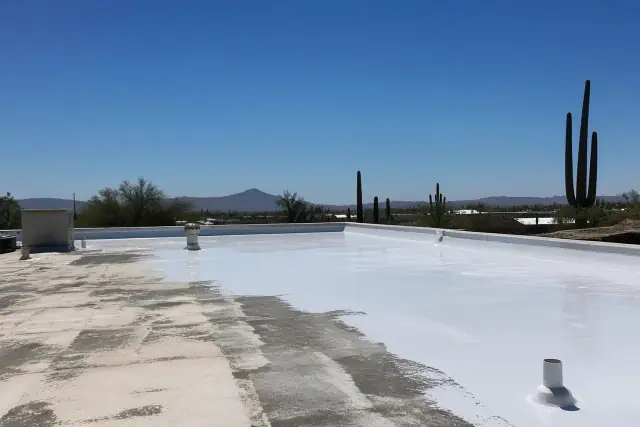
Freshly applied white acrylic roof coating on a flat rooftop under the bright sun in Tucson, AZ, with distant cacti.

Acrylic is a practical choice for many residential flat and low-slope roofs because it balances upfront cost, UV resistance, and reflectivity. It can adhere to foam, metal, and many existing cap sheets when the surface is compatible and correctly prepared.

Request Estimate

Elastomeric Flat Roof Coating

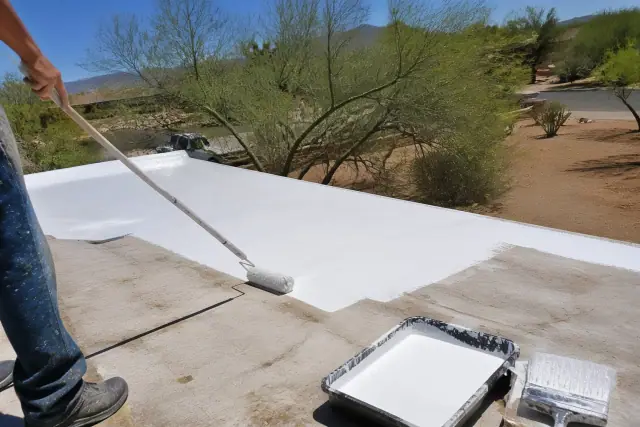
Applying white elastomeric coating to a flat roof in Tucson, AZ, with palo verde trees in the background.

Elastomeric membranes can stretch several hundred percent beyond their original size and return to shape, helping them absorb movement at parapets, roof-to-wall transitions, and other stress points. They are frequently used on patio covers, additions, and low-slope areas that need flexible waterproofing.

Request Estimate

Metal Roof Coating

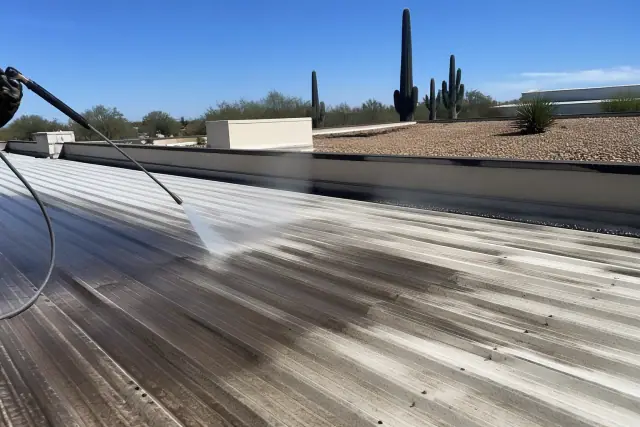
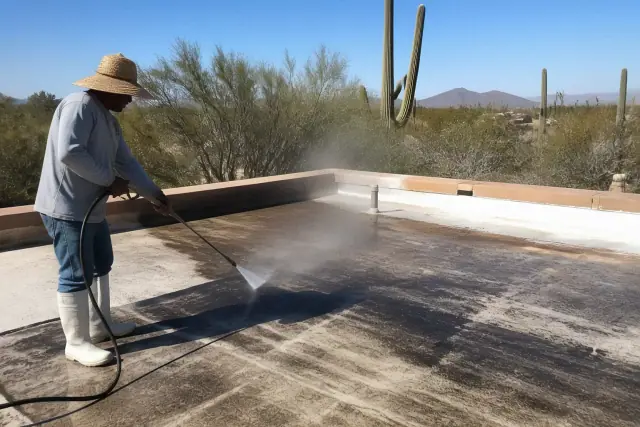
A pressure washer cleans a weathered metal roof in Tucson, AZ, with saguaro cacti and desert landscaping in the background.

Metal coating work begins with substrate identification and treatment of oxidized fastener heads and seams with a compatible rust-inhibitive primer. We match primer and topcoat chemistry to galvanized steel, galvalume, or aluminum and test adhesion on a small section before full application.

Request Estimate

Commercial Roof Coating

Commercial roof coating application on a building rooftop in Tucson, AZ, with buckets and roller marks visible.

Commercial coating can renew large TPO, modified bitumen, or built-up roof areas around rooftop equipment without the disruption of a full tear-off. Applications can be sectioned around building access and business hours, with low-odor formulations considered for occupied schools, medical facilities, offices, multi-family properties, and other sensitive spaces.

Request Estimate

Residential Roof Coating

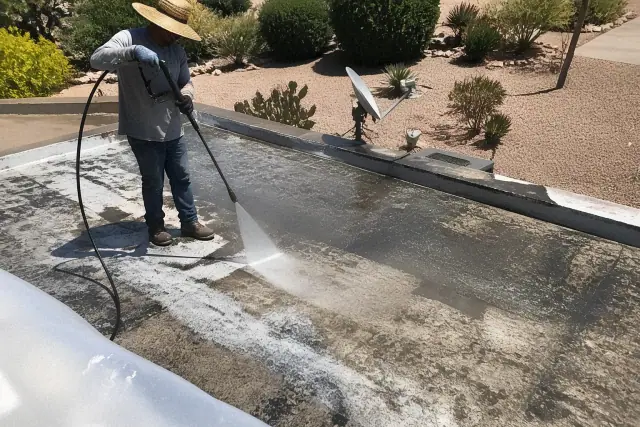
Contractor using a pressure washer to clean a residential roof in Tucson, AZ, before applying reflective coating.

Residential coating can protect flat and foam roofs, metal panels, and vulnerable flashing or valley details near tile fields. The same approach can be adapted to carports, pergolas, patios, sheds, mobile homes, and RV roofs when the surface is suitable for coating.

Request Estimate
Material Choices

Types of Roof Coating Options

Coating materials do not perform identically on every roof. The useful comparison is how each option handles UV, standing water, movement, insulation needs, substrate compatibility, maintenance, and the condition of the existing assembly.

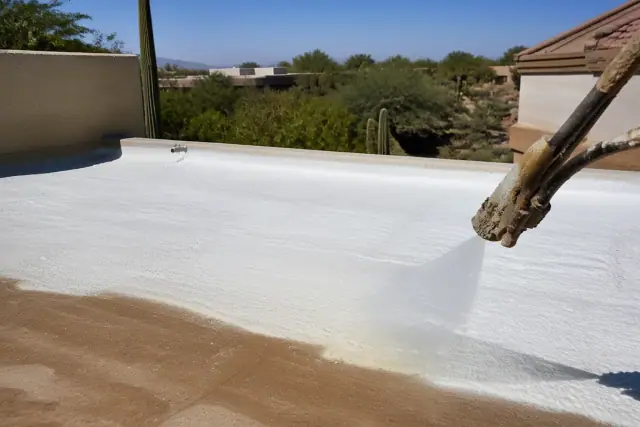
Freshly applied white acrylic elastomeric roof coating on a Tucson, AZ home with saguaro silhouettes in the background.

Acrylic Elastomeric Coating

Acrylic elastomeric coating cures into a reflective, flexible membrane and is the most common option we apply to compatible residential roofs. It works best when drainage is addressed, the surface is clean and dry, and the application receives a clear curing window.

  • Strong UV resistance for exposed Tucson roof surfaces
  • Reflective white or tinted finish
  • Compatible with foam, metal, and many cap sheets
  • Practical for many flat and low-slope residential roofs
  • Maintained by recoating every several years as weathering requires
Request Estimate
A thick layer of white silicone roof coating being applied to a weathered rooftop in Tucson, AZ with desert scenery.

Silicone Roof Coating

Silicone is the stronger fit where prolonged moisture or persistent ponding would degrade some other coating types. The roof still needs inspection and drainage correction where practical, but silicone offers useful water resistance on compatible low-slope surfaces.

  • Resists degradation from prolonged moisture contact
  • Useful on roofs with persistent ponding exposure
  • Can serve as a protective foam-roof topcoat
  • Requires compatible preparation and product selection
  • Applied only after moisture and substrate conditions are checked
Request Estimate
Contractor applying polyurethane foam roofing to a building in Tucson, AZ with desert landscaping in the background.

Polyurethane Foam Roofing

Polyurethane foam is typically installed as a complete roofing system rather than a simple maintenance coat. It provides insulation and waterproofing, then relies on an elastomeric or silicone topcoat to shield the foam from UV and moisture.

  • Adds insulation value with the waterproofing layer
  • Fits projects where energy performance is a priority
  • Can be shaped to address minor drainage conditions
  • Requires repair of delamination and soft spots before recoating
  • Needs a maintained protective topcoat
Request Estimate
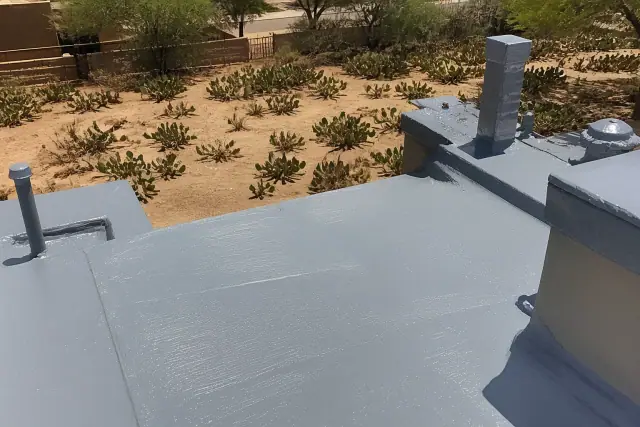
Freshly applied rubberized flexible coating on a flat roof in Tucson, AZ with desert cacti in the background.

Rubberized Flexible Coating

Rubberized systems are selected for roofs that see pronounced expansion and contraction. A Tucson roof deck can move from 45 degrees before sunrise to 170 degrees by 2 p.m., so elasticity at seams and penetrations is especially important during the hottest months.

  • Stays flexible across wide temperature changes
  • Helps protect seams where roof movement concentrates
  • Suited to harsh south- and west-facing exposure
  • Applied over a clean, dry, compatible substrate
  • Can reinforce vulnerable transitions and penetrations
Request Estimate
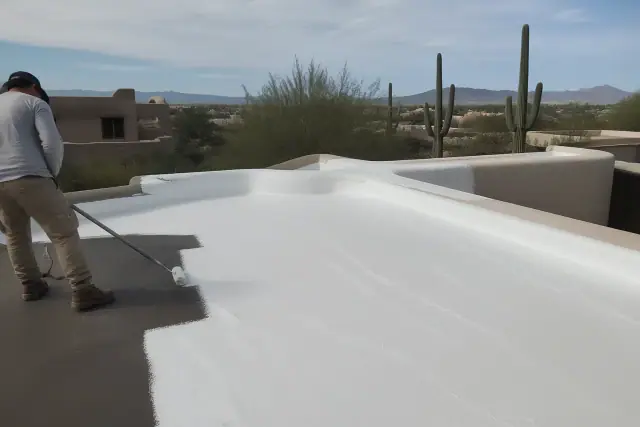
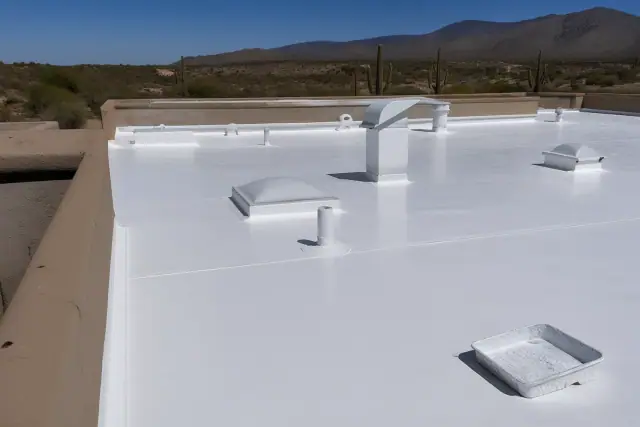
Completed white reflective roof coating on a commercial building with stucco parapets and desert views in Tucson, AZ.

White Reflective Coating

A white or reflective topcoat sends a significant share of solar radiation away from the building instead of absorbing it into an aged, dark membrane. Systems can be selected to align with the reflectivity and emissivity criteria used by the ENERGY STAR cool roof program.

  • Lowers roof-surface heat compared with a dark membrane
  • Reduces heat load moving into the building
  • Helps limit rooftop-unit run time on large flat roofs
  • Available for residential and commercial applications
  • Needs maintenance before chalking reduces reflectivity
Request Estimate
Finding the Right Fit

Choosing the Right Roof Coating Approach

Selection starts with the existing roof rather than a preferred product. We consider the substrate, slope, ponding, sun orientation, access, repairs, insulation goals, and budget, then match the primer and coating chemistry to those conditions. Acrylic often fits a sound residential low-slope roof, silicone is stronger around persistent moisture, polyurethane foam adds insulation as a complete system, and metal panels require a substrate-specific primer and adhesion test.

Full-Roof Evaluation

As a full roofing contractor, we look beyond the visible coating. The inspection checks substrate condition, deck rot, flashing, penetrations, drainage, foam delamination, and soft spots so a coating is recommended only when the underlying roof can support it.

Specification-Trained Application

Crew members applying coating systems are trained on manufacturer specifications and ASTM D6083 elastomeric coating standards. Product coverage, mil thickness, primer compatibility, curing conditions, and coat timing are treated as performance requirements rather than shortcuts.

Tucson Climate Knowledge

Our approach accounts for Sonoran Desert UV, late-May-through-September heat cycles, fast-building monsoon storms, and freeze-thaw swings in the Catalina foothills. When the scope requires a permit, we coordinate through the applicable City of Tucson or Pima County development services department.

What Sets Us Apart

Why Choose Tucson Quality Roofing for Roof Coating?

Coating performance depends as much on diagnosis and preparation as it does on the product in the bucket. Tucson Quality Roofing evaluates the full roof, explains repair needs before application, matches chemistry to the substrate, and provides a written estimate that breaks out material and labor. Our crews operate under Arizona Registrar of Contractors licensing requirements and carry liability insurance and bonding as required for roofing work in Pima County and the City of Tucson.

Request Roof Inspection

Extreme Heat and UV Exposure

Intense solar exposure breaks down unprotected membranes and turns aging surfaces chalky and heat-absorbing. A compatible reflective topcoat shields the roof from UV and reduces the surface heat passed into the attic or occupied space below.

Daily Thermal Movement

Daily expansion and contraction concentrates movement at seams, penetrations, parapets, and roof-to-wall transitions. Once an old membrane loses elasticity, those stress points can split, so flexible coating is most useful before widespread cracking becomes a leak.

Monsoon Ponding Water

A July or August monsoon cell can drop an inch of rain in under an hour, exposing slow drains and low areas quickly. Seams, pipe boots, and drain edges must be sealed, while slope or drainage problems should be corrected rather than buried under another coat.

Cracking and Chalking Coatings

Alligatoring, brittle cracks, fading, and a powdery surface indicate that an older coating has lost flexibility or reflectivity. Periodic inspection-especially after monsoon season-can identify weathering while a maintenance recoat is still a practical option.

Metal Corrosion and Peeling

Oxidized fasteners, spreading rust, and peeling often point to incomplete preparation or an incompatible primer. The wrong primer-to-metal pairing can fail within a season or two, which is why substrate identification and a small adhesion test come before full coverage.

Hidden Substrate Damage

Deck rot, extensive delamination, soft foam, failing flashing, and trapped moisture cannot be solved by coating over them. These conditions need repair or may make replacement the better choice, because sealing a compromised assembly only hides the failure temporarily.

How It Works

Our Roof Coating Process

A durable coating job follows a sequence: evaluate the roof, clean it, confirm it is dry, repair defects, match the coating to the substrate, and apply each coat within the product's coverage and weather requirements. The process is adjusted for metal, foam, acrylic, silicone, and commercial membrane conditions.

01.

Inspect the Roof Assembly

We walk the roof to identify the substrate, slope, drainage, seams, penetrations, flashing, soft spots, delamination, corrosion, and deck concerns. The findings determine whether coating, repair, or replacement is appropriate.

02.

Clean the Surface

Pressure washing removes dirt, chalking, and loose material that would interfere with adhesion. The roof is then allowed to dry fully before repairs, primer, or coating is applied.

03.

Scan for Moisture and Make Repairs

A moisture scan helps confirm the deck is dry and reveals areas that should not be sealed in place. We repair soft foam, delamination, flashing defects, seams, penetrations, and correctable drainage issues before coating.

04.

Match Primer and Coating

The product is selected for the existing material and moisture exposure. Metal projects may receive rust-inhibitive primer and a small adhesion test, while foam, cap sheet, and other membranes receive their compatible preparation system.

05.

Apply Base and Top Coats

Base and top coats are installed at the manufacturer-specified mil thickness, commonly using 1.5 to 2 gallons per 100 square feet depending on the product. Coverage is checked so thin areas do not undermine waterproofing or durability.

06.

Protect the Cure Window

We check the forecast before work begins and time coats so each layer can set without rain. The required dry window and full rain-ready cure depend on the coating, humidity, and application conditions, so a second coat is not rushed over material that has not set.

Plan the Right Next Step

Schedule a Roof Coating Inspection

If your roof is chalking, cracking, holding water, or showing exposed foam or corrosion, schedule an inspection before the damage reaches the interior. We will evaluate the assembly, explain whether coating is suitable, identify required repairs, and provide a written estimate for material and labor.

Roof Coating Help

Roof Coating FAQs

These answers cover roof coating cost, lifespan, curing, product selection, maintenance, roof suitability, and applications for Tucson properties. An on-roof inspection is still the best way to match the recommendation to the existing assembly.

Call Our Roofers

Residential roof coating in Tucson typically falls between $1,000 and $3,500, with acrylic systems commonly running roughly $1,000 to $2,500. Roof size, coating type, deck condition, access, and repairs affect the final amount, so Tucson Quality Roofing provides a written estimate after inspecting the roof. Larger commercial roofs are priced per square foot because their area and equipment penetrations vary.

A sound price reflects square footage, coating type, preparation, access, and repairs rather than using one flat amount for every roof. Extensive ponding, failing substrate, or damaged flashing increases the preparation needed, which is why an on-site inspection is more reliable than a phone-only estimate.

Coating cannot repair a structurally compromised deck, extensive delamination, major ponding, or failed flashing by itself. It also requires inspection and reapplication on a maintenance cycle rather than serving as a permanent substitute for replacement. Coating the wrong candidate can trap an underlying problem and make the owner pay for correction later.

A coating can add roughly 5 to 15 years of service life when the roof is structurally sound. Product type, application thickness, sun orientation, and maintenance all affect that range, with south- and west-facing areas tending to weather faster. By comparison, a full roof replacement typically lasts 20 to 30 years or more.

Most acrylic and elastomeric coatings need a minimum dry window of 4 to 8 hours in typical Tucson heat before light moisture, while a full rain-ready cure often takes 24 hours depending on humidity and product. The forecast must be checked carefully during monsoon season because starting too late or recoating before the first layer sets can lead to early failure.

Acrylic is the most affordable and widely used choice for many residential flat and low-slope roofs, with useful UV resistance and reflectivity. Silicone better resists prolonged moisture and persistent ponding. Polyurethane foam adds insulation and waterproofing as a complete system, then needs a protective topcoat.

Yes. Our crews operate under Arizona Registrar of Contractors licensing requirements, and we carry liability insurance and bonding as required for roofing work performed in Pima County and the City of Tucson. We also coordinate permits and inspections through the appropriate local building department when the scope requires them.

A compatible coating can seal seams, pipe boots, drain edges, and hairline cracks on a structurally sound flat roof. It will not solve rotted decking, extensive delamination, failed flashing, or major slope and ponding problems unless those conditions are repaired first.

Yes, compatible coatings can protect galvanized steel, galvalume, and aluminum roofs when corrosion and adhesion are addressed first. Oxidized fasteners and seams may need a rust-inhibitive primer, and a small adhesion test helps confirm the primer and topcoat match the metal.

The foam is inspected for delamination, soft spots, exposed areas, and moisture concerns. Damaged foam is repaired before an elastomeric or silicone topcoat is applied to restore UV and moisture protection. Maintenance recoating is important because exposed foam degrades in direct sunlight.

A white or reflective coating can lower surface temperature compared with a dark, aged membrane and reduce the heat load transferring into the building. On large flat commercial roofs, that can reduce rooftop-unit run time and cooling demand across the Tucson Electric Power service territory, although actual savings vary by building and roof assembly.

A reflective commercial coating can extend the interval before full replacement by 5 to 10 years in many tracked Sonoran Desert commercial applications. Suitability depends on the condition of the TPO, modified bitumen, built-up roof, seams, equipment penetrations, and underlying deck.

Compatible coatings can be used on commercial buildings, warehouses, factories, offices, shopping centers, hospitals, schools, churches, apartments, and multi-family properties. Smaller surfaces such as carports, pergolas, patios, sheds, mobile homes, and RV roofs may also be candidates after the substrate and condition are checked.