Proudly serving Tucson, Oro Valley, Marana, Sahuarita, Green Valley, Vail & surrounding areasCall or Text 24/7: 520-569-2109

Commercial Roofing Contractor for Flat, Foam & Metal Systems in Tucson, AZ

Tucson Quality Roofing is a licensed roofing contractor serving commercial properties across Tucson with flat roof repair, roof replacement, roof coating, foam roofing, metal roofing, and emergency roof leak repair. We work on TPO, EPDM, modified bitumen, built-up, single-ply, foam, and metal panel systems. Property managers, retail owners, and industrial facility operators receive recommendations based on the roof's actual condition. Our crews also handle residential systems, but this page focuses on commercial buildings.

Tucson commercial roofs can move from surface temperatures above 150 degrees after three months of summer heat into sudden monsoon rain. That thermal cycling stresses membranes, flashing, seams, and fasteners, while windblown desert dust can block drains and scuppers. Our licensed and insured crews inspect the actual failure point, coordinate required permits through the City of Tucson Development Services Department or Pima County, and explain repair-versus-replacement tradeoffs. You receive an itemized written scope, material breakdown, and timeline before work begins.

For active leaks, we prioritize emergency calls with tarping and temporary sealing before permanent repairs. For planned work, we schedule around business hours and the monsoon forecast to reduce disruption.

Tucson Quality Roofing provides commercial roofing throughout Tucson, Oro Valley, Marana, Sahuarita, and the greater Pima County metro area.

★ ★ ★ ★ ★4.9/5 Average Rating · 20+ Years of Experience · Thousands of Customers Helped · Licensed & Insured · Residential & Commercial

Commercial Roofing Options & Benefits

What Is Commercial Roofing?

Commercial roofing covers the low-slope and specialty roof systems used on retail centers, offices, warehouses, industrial facilities, and multi-tenant properties. The work may involve targeted leak repair, preventive coating, maintenance, or a complete roof replacement.

In Tucson, the swing between a 108-degree July afternoon and a monsoon downpour that same evening places severe stress on seams, fasteners, coatings, and flashing. Selecting a system therefore requires attention to UV exposure, thermal movement, drainage, reflectivity, insulation, and wind uplift resistance.

The right approach depends on the existing membrane, deck condition, insulation requirements, rooftop equipment, drainage work, and whether the roof can be repaired or restored without a tear-off. A physical inspection and itemized estimate make those tradeoffs clear before a contract is signed.

Benefits of Professional Commercial Roofing

A commercial roofing plan should protect the building, support energy performance, and give ownership a predictable path for repairs and capital planning. The most useful benefits come from matching the work to the existing system and documenting what the roof actually needs.

  • Leak-source diagnosis using visual inspection and moisture scanning
  • Low-slope repair options tailored to the existing membrane
  • Reflective coatings and materials that reduce rooftop heat gain
  • Rebuilt flashing and drainage details at vulnerable roof areas
  • Written scopes, material breakdowns, and project timelines
  • Permit coordination with the correct local building authority
  • Photo documentation and written condition reports
  • Maintenance schedules based on roof age, material, and condition
Roofing for Tucson Businesses

Commercial Roofing Services

From isolated flat-roof leaks to complete system upgrades, our commercial roofing services address the problems Tucson property managers and facility operators face most often. Each recommendation starts with the existing roof condition rather than a predetermined product.

Flat Roof Repair

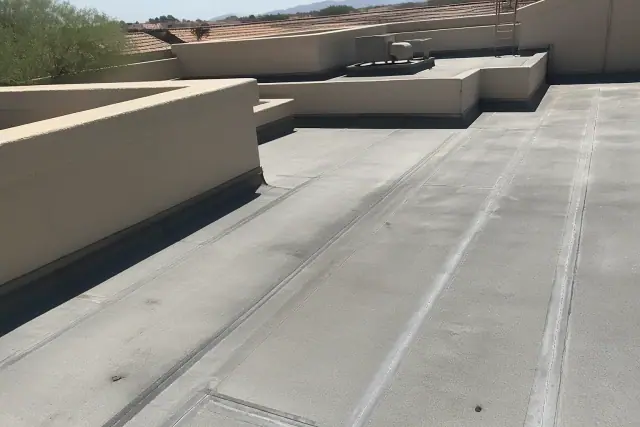
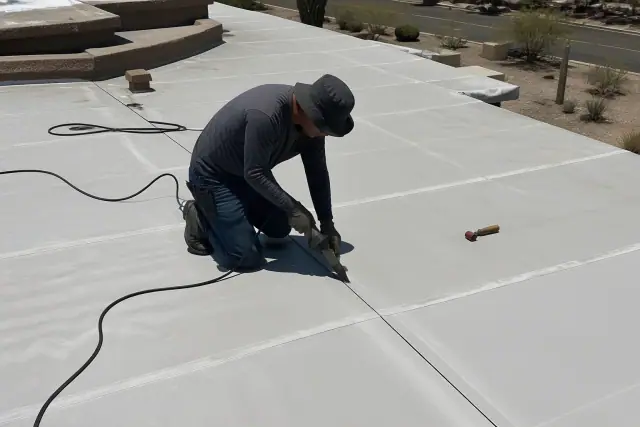
Heat-welded repair seams on a commercial flat roof membrane in the bright desert sunlight of Tucson, AZ.

We isolate the leak source with a moisture scan, cut back damaged membrane, clean the deck, and install a compatible patch or membrane section. Heat-welded or adhered seams are selected for the system, while flashing at parapet walls, HVAC curbs, and penetrations is rebuilt as needed to current code standards.

Request Estimate

Commercial Roof Replacement

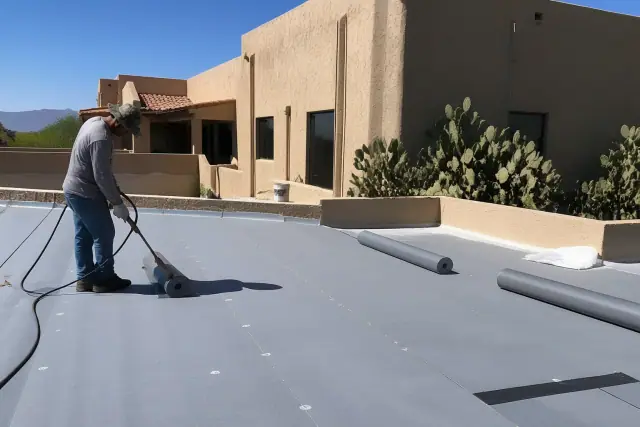
Contractor installing a heat-welded commercial roof membrane on a building in Tucson, AZ.

A complete replacement begins with tear-off to the deck, substrate inspection and repair, and new insulation that meets current energy code. The new roofing system is then installed with flashing, drainage, and penetration details rebuilt, with work scheduled around business operations whenever possible.

Request Estimate

Emergency Roof Leak Repair

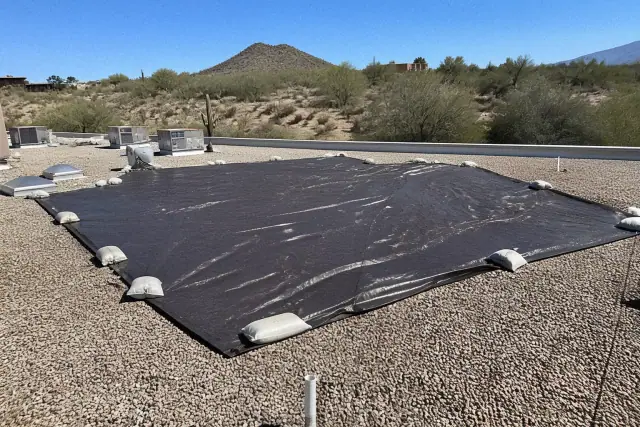
Heavy-duty reinforced tarp secured with sandbags over a damaged commercial roof section in Tucson, AZ.

A monsoon cell can drop an inch of rain in under an hour, putting inventory, equipment, ceilings, and insulation at risk. Because every hour that water remains in a ceiling cavity increases the chance of mold growth and insulation damage, we prioritize emergency calls with tarping and temporary sealing before completing the permanent source repair.

Request Estimate

Metal Roofing

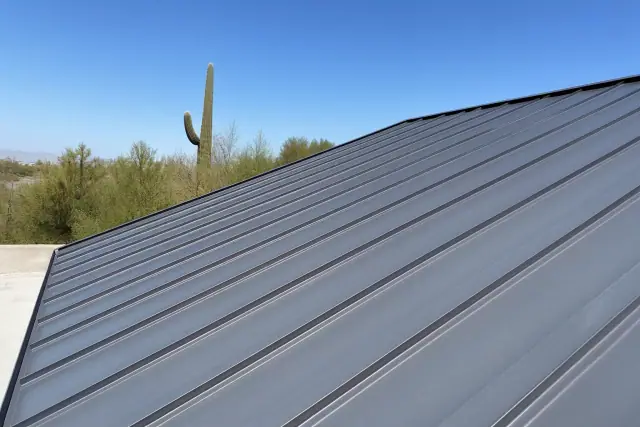
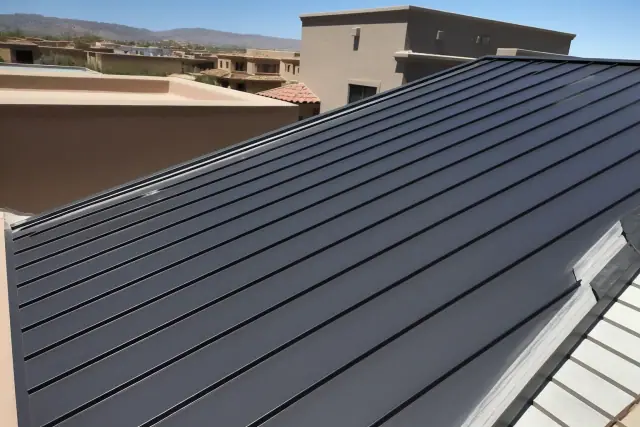
Standing seam metal roof installation on a commercial building under bright desert sun in Tucson, AZ.

Standing-seam and corrugated metal panels reflect solar radiation and can reduce heat transfer during Tucson's five-month cooling season. A properly installed metal roof commonly lasts 40 to 60 years, and correct seam, fastener, underlayment, wind-uplift, and expansion details help it handle desert temperature swings and storm gusts.

Request Estimate

Foam Roofing

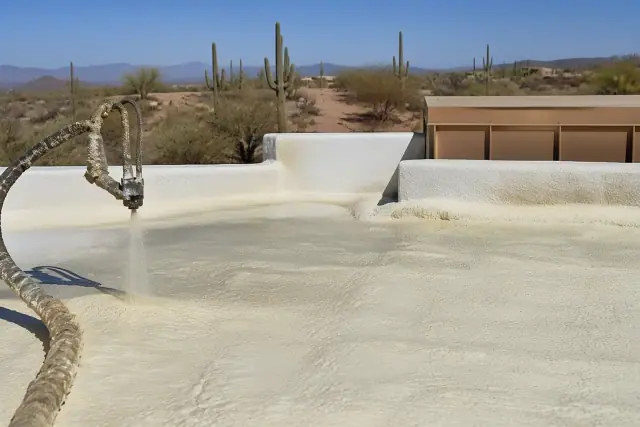
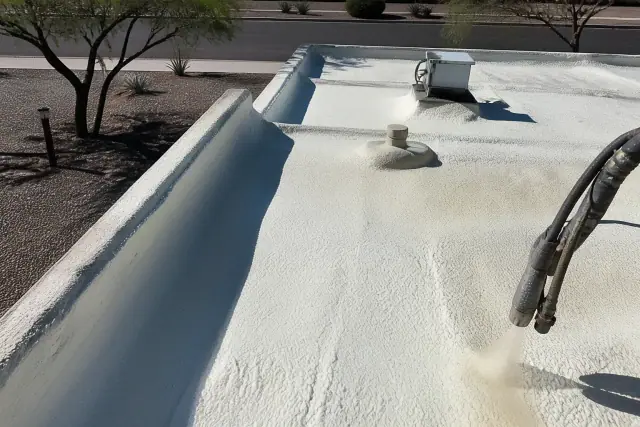
Contractor spraying polyurethane foam insulation on a commercial roof in Tucson, AZ, with a desert landscape background.

Spray polyurethane foam expands into a seamless, fully adhered membrane that conforms around drains, curbs, and penetrations while providing continuous insulation without thermal bridging. Paired with a reflective top coating, it can reduce rooftop heat gain; larger commercial buildings commonly see cooling-cost reductions of several thousand dollars annually, with lifecycle savings compounding over a 20 to 30 year roof life.

Request Estimate

Roof Coating

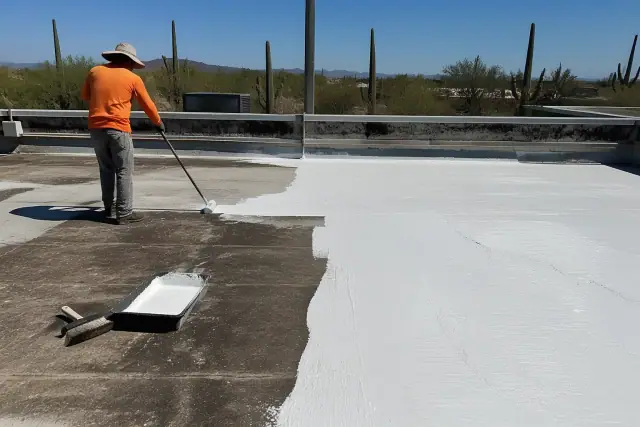
White elastomeric roof coating being applied to a flat commercial roof with saguaro cacti in the distance in Tucson, AZ.

Acrylic, silicone, and elastomeric coatings can renew UV and waterproofing protection when the existing deck and membrane remain sound. Preparation includes power washing, repairing damaged seams and blisters, and applying the coating in multiple passes to the required dry film thickness measured in mils.

Request Estimate
Low-Slope and Specialty Systems

Commercial Roofing System Options

TPO, EPDM, modified bitumen, built-up roofing, spray polyurethane foam, and metal each respond differently to Tucson's UV load and thermal cycling. We compare reflectivity, expected service life, insulation needs, drainage, repairability, and upfront cost so the selected system fits the building and budget.

Professional applying heat-welded seams to a TPO and EPDM commercial roof in Tucson, AZ.

TPO and EPDM Single-Ply Roofing

TPO and EPDM are single-ply choices for flat commercial buildings. The inspection and scope account for membrane condition, seam type, insulation, drainage, and the details around rooftop equipment before repair or replacement is recommended.

  • Designed for low-slope commercial roof decks
  • Heat-welded or adhered seam work based on the membrane
  • Inspection for split seams and membrane blistering
  • Detailed flashing at parapets, curbs, and penetrations
  • Insulation and drainage included in system planning
Request Estimate
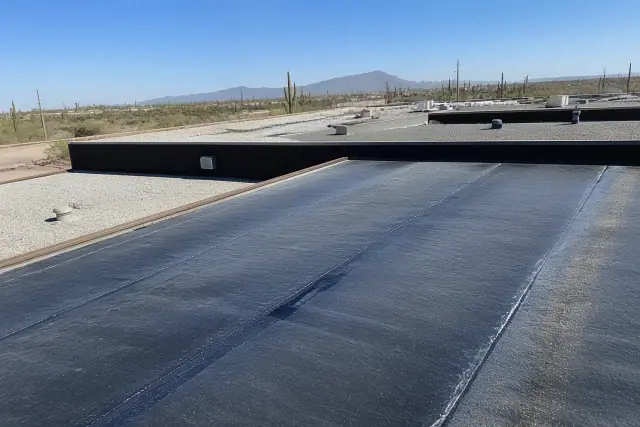
Heat-welded modified bitumen roofing seams on a commercial building rooftop in Tucson, AZ.

Modified Bitumen Roofing

Modified bitumen is one of the standard low-slope systems used on Tucson commercial buildings. Repair planning starts with moisture findings and the condition of the membrane, deck, seams, flashing, drainage, and insulation.

  • Suitable for commercial low-slope roof applications
  • Moisture scanning helps define damaged sections
  • Deck condition is checked before membrane work
  • Seams and flashing are repaired with the roof section
  • Drainage and insulation needs are included in the scope
Request Estimate
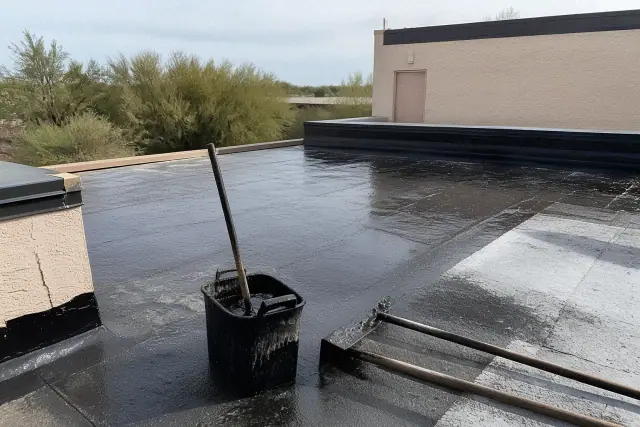
Built-up roofing installation with bitumen and asphalt tools on a commercial building rooftop in Tucson, AZ.

Built-Up Roofing

Existing built-up roofing is evaluated for active moisture, surface wear, drainage performance, and the condition of flashing and penetrations. Findings determine whether targeted repair, protective restoration, or replacement is the more practical path.

  • Condition-based repair or replacement planning
  • Drain and scupper cleaning for monsoon readiness
  • Flashing review at edges and rooftop equipment
  • Surface assessment for UV-related wear
  • Moisture findings tied to deck and insulation decisions
Request Estimate
Operator applying spray polyurethane foam insulation to a commercial roof in Tucson, AZ.

Spray Polyurethane Foam Roofing

Spray polyurethane foam is applied as a liquid and cures into a seamless, fully adhered roof membrane. It conforms to the irregular drainage and penetration details found on many flat-roofed Tucson retail and office buildings.

  • Seamless coverage across low-slope roof surfaces
  • Fully adhered application around drains and curbs
  • Continuous insulation without thermal bridging
  • Reflective top coating for UV protection
  • Planned inspection and recoating for long-term performance
Request Estimate
Standing seam metal panels being installed on a sloped commercial roof in Tucson, AZ.

Metal Panel Roofing

Standing-seam and corrugated panel systems are used on warehouses, agricultural buildings, and light industrial structures. Material selection and installation details account for reflectivity, thermal expansion, storm gusts, and the building's structural layout.

  • Standing-seam and corrugated panel options
  • Solar reflectivity that limits heat transfer
  • Expansion allowances for daily temperature swings
  • Seam and fastener patterns planned for wind uplift
  • Underlayment selected as part of the complete assembly
Request Estimate
Finding Your Right Fit

Choosing the Right Commercial Roofing Approach

The best path may be a focused repair, a restoration coating, or full replacement, depending on moisture, deck condition, membrane age, active leaks, insulation requirements, and drainage. We present the findings, system tradeoffs, and costs in writing so owners can make a capital decision that fits the building rather than relying on a generic recommendation.

Documented Scope and Pricing

Every project starts with a written scope, material breakdown, itemized estimate, and timeline before work begins. Owners can see what drives the recommendation and cost instead of signing against an ambiguous lump sum.

Tucson Climate Planning

System selection, drainage work, coating preparation, and maintenance timing are planned around Sonoran Desert UV exposure, thermal cycling, dust, and the summer monsoon calendar. This local context helps focus the work on the conditions that repeatedly damage Tucson commercial roofs.

Licensed and Insured Crews

Our crews hold current licensing through the Arizona Registrar of Contractors and carry full insurance. Required permits are coordinated through the City of Tucson Development Services Department or Pima County based on the property's jurisdiction.

What Sets Us Apart

Why Choose Tucson Quality Roofing for Commercial Roofing?

Property managers, retail owners, and industrial facility operators need a contractor who identifies the actual roof failure and explains the path forward. Tucson Quality Roofing combines documented inspections, itemized recommendations, local permit coordination, and scheduling around business operations to keep the decision clear and accountable.

Request Free Roof Inspection

Ponding Water

Water that remains on a flat roof adds weight and accelerates membrane breakdown. In Tucson, windblown desert dust can clog drains and scuppers before a monsoon, allowing rain to back up across low areas.

Split Membrane Seams

Repeated heating and sudden cooling can pull at single-ply seams until they separate. Moisture scanning helps trace the leak source so the damaged membrane can be cut back and repaired with the seam method appropriate to the existing system.

Membrane Blistering

Blisters signal that sections of the roof membrane have lost sound adhesion or trapped moisture. Isolated damage may be repairable, while widespread blistering is one of the clearest signs that replacement deserves consideration.

Clogged Drains and Scuppers

Dust and debris accumulate quickly in Tucson roof drains and scuppers. Routine cleaning before storm season helps water leave the roof instead of ponding around seams, flashing, and low points.

Failing Flashing Details

Cracked, lifted, or missing flashing at parapet walls, HVAC curbs, pitch pans, and penetrations gives rain a direct route into the roof assembly. Interior staining, bubbling paint, and musty odors near those areas can indicate an active leak.

UV-Degraded Coatings

A coating that has broken down under Tucson's UV exposure loses reflectivity and waterproofing protection. If the deck and membrane remain sound, preparation and recoating can restore that protective surface without a full tear-off.

How It Works

Our Commercial Roofing Process

The process moves from documented roof conditions to a clear scope and system-specific work. Inspection, material selection, permit coordination, installation details, and future maintenance are connected so ownership understands both the immediate project and the roof's longer-term needs.

01.

Inspect and Scan the Roof

We inspect membrane condition, seam integrity, flashing, drainage, and insulation moisture. Infrared or capacitance moisture scanning is used where needed to isolate wet areas and the actual source of leaks.

02.

Document Conditions and Costs

Inspection findings are documented with photos and a written report that can support insurance or capital planning. The estimate then breaks out the proposed scope, materials, cost drivers, and timeline.

03.

Select the Repair or System

We compare a targeted repair, restoration coating, and replacement against the roof's age, material, moisture, deck, insulation, and drainage findings. For replacement, we also explain tradeoffs in reflectivity, service life, and upfront cost among the appropriate materials.

04.

Coordinate Permits and Scheduling

Required permits are pulled through the appropriate local building authority before work begins. We plan around business hours and Tucson's monsoon forecast whenever possible to limit operational and weather disruption.

05.

Prepare and Complete the Roof Work

Repair work begins by removing damaged material and cleaning the deck before compatible membrane and seam work. Replacement includes tear-off, substrate repair, code-compliant insulation, the selected roof system, and rebuilt flashing, drainage, and penetration details.

06.

Build the Maintenance Plan

The maintenance schedule is tailored to the roof's age, material, and condition findings. Drain cleaning, seam checks, coating care, and targeted repairs are timed around the monsoon calendar to help prevent premature replacement and recurring interior damage.

Plan Your Roof Work

Schedule a Commercial Roofing
Inspection

Request a physical roof inspection and a straight answer about whether your building needs repair, restoration, maintenance, or replacement. We will document the condition and provide an itemized scope so you can plan the next step around your property and operations.

Commercial Roof Help

Commercial Roofing FAQs

These answers cover commercial roof costs, system choices, repair decisions, inspection timing, maintenance, and project scheduling for Tucson properties. A physical inspection is still needed to determine the right scope for a particular building.

Call Our Roofing Team

Commercial roofing in the Tucson market typically ranges from about $5 to $12 per square foot, depending on the system. A 10,000-square-foot building might cost from $50,000 to well over $120,000 for full replacement based on deck condition, insulation requirements, drainage work, rooftop equipment, and tear-off complexity. TPO and modified bitumen are generally toward the lower end, while foam roofing with high-build insulation can be higher. We provide an itemized estimate after a physical inspection.

The 25 percent rule refers to a common code and industry practice in which repair costs reaching roughly 25 percent of full replacement can require the affected roof section to be brought up to current energy and building code instead of patched piecemeal. The exact requirement can depend on the jurisdiction and roof section. We account for that threshold when comparing repair and replacement recommendations.

Verify the contractor's license through the Arizona Registrar of Contractors and confirm active liability insurance and workers' compensation coverage. Ask for a written, itemized scope and be cautious of pressure to sign immediately or pay the full amount upfront. A second opinion is reasonable when a repair request turns into a replacement recommendation.

Commercial roofing commonly covers retail centers, offices, and multi-tenant properties using TPO, EPDM, modified bitumen, or foam on low-slope decks. Industrial roofing often involves warehouses, manufacturing facilities, and distribution centers with larger spans, heavier rooftop equipment loads, and metal panel systems. Industrial buildings may also have different ventilation, fire-rating, and equipment-curb requirements.

The most frequent issues are ponding water, seam separation from thermal cycling, cracked or missing flashing, and UV-degraded coatings. Windblown desert dust also clogs drains and scuppers, contributing to leaks during monsoon rain. Interior warning signs include stained ceiling tiles, bubbling paint, and musty odors near rooftop penetrations or parapet walls.

The three main components are the roof membrane or covering, the insulation layer that manages energy performance and R-value, and the flashing and drainage components that control water at edges, penetrations, and low points. Failure in any one of these areas can lead to leaks and interior damage.

A straightforward recoat or foam application on a smaller commercial building might take a few days. A full tear-off and replacement on a larger warehouse or retail center can take one to three weeks. Square footage, system type, deck work, rooftop equipment, and weather all affect the schedule, so we provide a written timeline before starting.

We work with TPO, EPDM, modified bitumen, built-up roofing, single-ply systems, spray polyurethane foam, coatings, and metal panel roofing. The appropriate choice depends on the existing roof, deck condition, insulation targets, drainage, reflectivity, repairability, and budget.

We start by isolating the leak source with a moisture scan. Damaged membrane is cut back, the deck is cleaned, and a compatible patch or membrane section is installed with heat-welded or adhered seams according to the system. Flashing at parapets, HVAC curbs, and penetrations is rebuilt where needed.

A properly applied coating system can extend the service life of an existing roof by 10 years or more when the deck and membrane are still sound. The roof must first be power washed and prepared, with damaged seams and blisters repaired before acrylic, silicone, or elastomeric coating is applied to the proper dry film thickness.

Foam roofing generally needs a recoat every 10 to 15 years to maintain UV protection and waterproofing. Between recoats, we recommend annual inspection so mechanical damage from foot traffic or hail can be addressed before it reaches the insulation layer.

For most commercial systems, we recommend bi-annual inspections timed before and after monsoon season. The schedule is customized to the roof's age, material, and condition, with drain cleaning, seam checks, and targeted repairs included as findings require.

Widespread blistering, multiple active leaks, and a membrane past 20 years of service life are strong indicators that replacement should be evaluated. Deck damage, outdated insulation, recurring drainage failures, and the cost of repeated repairs also affect the decision. We compare those conditions in a written repair-versus-replacement recommendation.